mercredi 19 mars 2014

Les plantes sont des organismes sensibles qui communiquent à l'aide d'ultrason!!

Une étude fascinante sur la communication chez les végétaux: gracieuseté de l'Université d'Oxford....

Article au complet
Source:
http://beheco.oxfordjournals.org/content/24/4/789.full


Figure 1
Figure 1
A putative model of a mechanism underlying sound production in plants. Plant cells vibrate as a result of the active movement of organelles within the cell (i.e., cytoplasmic streaming; orange arrows in panel B). Cytoplasmic streaming is caused by the activity of motor protein myosins as they slide along actin filaments using the hydrolysis energy of adenosine triphosphate (panel C). As the nanomechanical motion generated within a cell reflects the unique metabolic status of that cell, this information is contained in the emitted vibrational wave. Vibrations from individual cells propagate through the medium as sound waves and reach neighboring cells; if the receiving cells are receptive to that particular frequency, they will also start vibrating proportionally to the intensity of the received signal and when all the cells are “in tune,” the signal is amplified (panel D). As the signal extends outside the leaf or root of the plant, it conveys information about that plant to neighboring plants or other organism (panel A).


In conclusion, a considerable body of evidence emerging from contemporary research in the plant sciences is increasingly recognizing plants as highly sensitive organisms that perceive, assess, interact, and even facilitate each other by actively acquiring information from their environment (Karban 2008; Baluška 2009; Trewavas 2009). We now know, for example, that when attacked, plants “cry for help” by producing volatiles that attract carnivorous enemies of the attacking herbivores (Dicke 2009); and on the other hand, parasitic plants can recognize their prey at a distance and evaluate their nutritional value before deciding to invade them (Kelly 1992; Koch et al. 2004). Considering that these are only a very few examples of what plants do, the Aristotelian view of plants as automata-like passive and insensitive creatures seems to be no longer accurate. By relinquishing this out-of-date view of the plant world, I hope the ideas and questions presented here seduce the most enquiring aspect of our nature into exploring the world of plants in its full potential complexity.

mardi 18 mars 2014

La terre tremble

Tremblement de terre des derniers jours
Source:
http://www.iris.edu/seismon/
http://www.emsc-csem.org/Earthquake/seismologist.php

Météorite aperçu au Québec

Une boule de feu a été aperçue au-dessus de la Baie-des-Chaleurs, tôt mardi matin. Elle aurait aussi été vue au Saguenay, en Nouvelle-Écosse et au Nouveau-Brunswick.

Environ 20 personnes ont rapporté le phénomène à la Sûreté du Québec (SQ), un peu après 4 h, selon Claude Doiron, porte-parole de la SQ pour le district du Bas-Saint-Laurent-Gaspésie-Îles-de-la-Madeleine.
Plusieurs habitants de la Baie-des-Chaleurs qui vivent près de la ville de Chandler ont affirmé avoir vu une boule lumineuse traverser le ciel, suivi d'une forte détonation.  Des citoyens auraient même senti leur maison trembler et affirmé que tout le village a été éclairé comme en plein jour, le temps de quelques secondes.
Dans le secteur de St-Edgar, il y aurait eu une baisse de tension électrique au moment du passage de la météorite.
Des policiers en poste à New Richmond sont sortis après la détonation, pensant assister à l'écrasement d'un avion.
«Lorsque le phénomène s'est produit à 4 h 5 ce matin, nos policiers ont été témoins du phénomène. Même un de nos postes dans la Baie-des-Chaleurs en a vibré, a affirmé Claude Doiron. Il est fréquent d'apercevoir des météores dans la région, mais celui-ci semble être tombé très près des régions habitées», a déclaré Claude Doiron.
Bien que la boule de feu ne semble avoir fait aucun dommage ou de point de chute au sol pour l'instant, la Gendarmerie royale du Canada va mener une enquête.
Vue en Nouvelle-Écosse et au Nouveau-Brunswick
Le phénomène a aussi été aperçu en Nouvelle-Écosse et au Nouveau-Brunswick. Steve Betts, a indiqué sur Twitter qu'il conduisait vers l'aéroport d'Halifax, lorsqu'à 5 h 7, il a vu «quelque chose qui tombait du ciel en flammes».
«Cela a laissé une traînée de feu dans le ciel, puis c'est devenu vert et cela a disparu. Je présume qu'il ne s'agit pas d'un avion, alors c'est peut-être un météorite?», a-t-il écrit.
Jan Fletcher a aussi écrit sur Twitter qu'il avait vu quelque chose de semblable. «Je me suis réveillé et j'ai vu une boule de feu qui tombait du ciel dans une zone près du lac. Est-ce un météorite?» Il a précisé plus tard : «La boule de feu que j'ai aperçue ce matin a aussi été vue par une personne à Northumberland et une autre à Truro. C'est sûrement un météorite».
Un dénommé Danny a aussi rapporté sur Twitter qu'il avait vu «une lumière vive suivie d'une boule de feu», aux alentours de 5 h 10 près de l'aéroport de Moncton au Nouveau-Brunswick.
 Source:
http://tvanouvelles.ca/lcn/infos/regional/estduquebec/archives/2014/03/20140318-102954.html
http://www.lapresse.ca/sciences/astronomie-et-espace/201403/18/01-4748956-un-meteore-apercu-dans-les-maritimes-et-en-gaspesie.php


vendredi 29 novembre 2013

ISON still alive

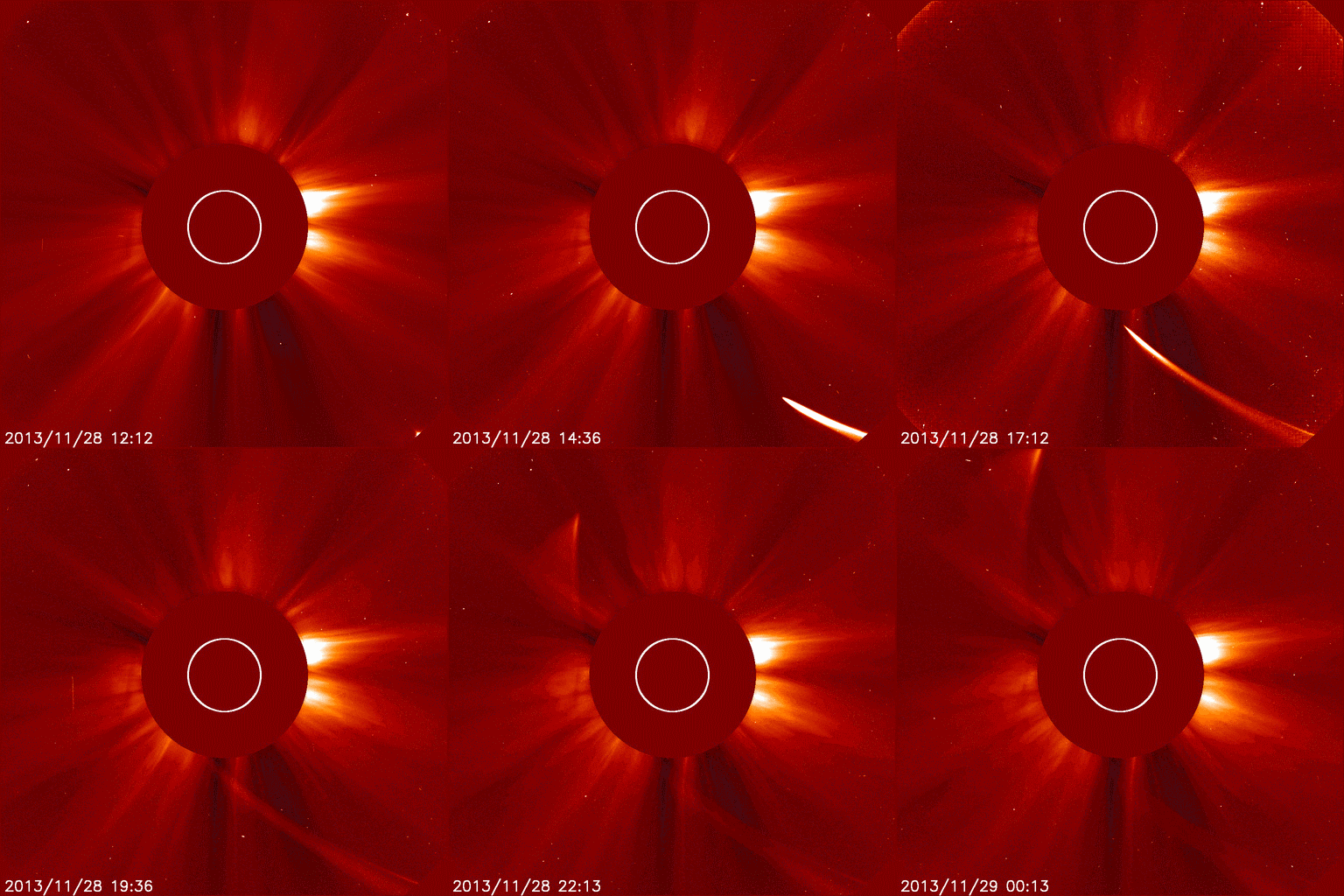
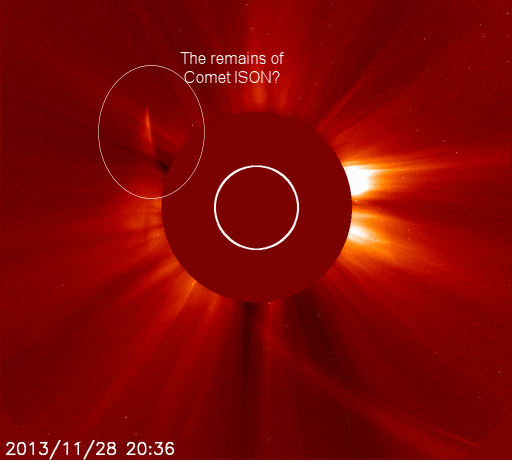
COMET ISON LIVES (UPDATED): Cancel the funeral. Comet ISON is back from the dead. Yesterday, Nov. 28th, Comet ISON flew through the sun's atmosphere and appeared to disintegrate before the cameras of several NASA and ESA spacecraft. This prompted reports of the comet's demise. Today, the comet has revived and is rapidly brightening. Click to view a SOHO coronagraph movie of the solar flyby (updated Nov. 29 @ 1800 UT):
Before the flyby, experts had made many predictions about what might happen to the comet, ranging from utter disintegration to glorious survival. No one predicted both.
Karl Battams of NASA's Comet ISON Observing Campaign says, "[colleague] Matthew Knight and I are ripping our hair out right now as we know that so many people in the public, the media and in science teams want to know what's happened. We'd love to know that too! Right now, here's our working hypothesis:
"As comet ISON plunged towards to the Sun, it began to fall apart, losing not giant fragments but at least a lot of reasonably sized chunks. There's evidence of very large dust in the long thin tail we saw in the [SOHO coronagraph] images. Then, as ISON plunged through the corona, it continued to fall apart and vaporize, losing its coma and tail completely just like sungrazing Comet Lovejoy did in 2011. What emerged from the Sun was a small but perhaps somewhat coherent nucleus that has resumed emitting dust and gas for at least the time being."
Battams emphasizes that it is too soon to tell how big the remnant nucleus is or how bright the resurgent comet will ultimately become. "We have a whole new set of unknowns, and this ridiculous, crazy, dynamic and unpredictable object continues to amaze, astound and confuse us to no end. We ask that you please be patient with us for a couple of days as we analyze the data and try to work out what is happening."
Astrophotographer Babak Tafreshi has edited an HD video that compares views of ISON from both of SOHO's coronagraphs. "It seems the comet could become a naked eye object with several degrees of scattered tail by Dec 2nd or 3rd," he predicts. "It's not the comet of the century for sure, and fainter than the Lovejoy sungrazer in Dec. 2011, but an interesting imaging target is just a few nights away!" Solar flare alerts: text, voice

Source:
http://www.spaceweather.com/ 

Small meteor fragment falls into the Ionian Sea


ANA-MPA -- A small meteor fragment hit the earth's atmosphere over the Ionian Sea in northwest Greece on Wednesday night, blazing across the sky as it burned up and alarming the people on the islands of Cephalonia and Zakynthos where the phenomenon was most visible, as well as in the western cities of Ioannina and Patras. No injuries or damage were reported.
 People who witnessed the meteor fall into the sea reported a bright light across the sky and a loud thundering sound at approximately 21:30 on Wednesday night. 
Academy of Athens Astronomy Research Center Director Panos Patsis told ANA-MPA that “rocks fall from the sky all the time”, noting that such phenomena are not unusual and most likely it was a small meteor or a fragment of a comet with a diameter of less than a meter. He said that most of the time they go unnoticed because they end up in the sea or in remote unpopulated areas on the Earth. 
Eugenides Foundation Planetarium Director Dionissis Simopoulos noted that more than 100 tons of meteors fall on the earth's surface everyday. He said that the meteor piece that fell last night couldn't be larger than a human head in size and probably weighed approximately two-and-a-half kilos. 
Both ruled out the likelihood that it was a fragment of ISON, the so-called comet of the century, which is expected to graze the surface of the Sun on Thursday night. They also said that there is a small likelihood it was a leftover from the Leonid Meteor Shower, as the phenomenon had culminated earlier in the month.


(file photo)


Μore on subscrider' s page | application

jeudi 28 novembre 2013

ISON News

CANCEL THE EULOGY ... FOR NOW: Comet ISON flew through the sun's atmosphere on Nov. 28th and the encounter did not go well for the icy comet. Just before perihelion (closest approach to the sun) the comet rapidly faded and appeared to disintegrate. This prompted reports of ISON's demise. However, a fraction of the comet might have survived. Click on the image below to see what emerged from Comet ISON's brush with solar fire:
In the movie, Comet ISON seems to be falling apart as it approaches the sun. Indeed, researchers working with NASA's Solar Dynamics Observatory said they saw nothing along the track that ISON was expected to follow through the sun's atmosphere. Nevertheless, something has emerged. Whether this is a small scorched fragment of Comet ISON's nucleus or perhaps a "headless comet"--a stream of debris marking the remains of the comet's disintegrated core--remains to be seen.
An earlier movie from SOHO shows more of the comet's approach:
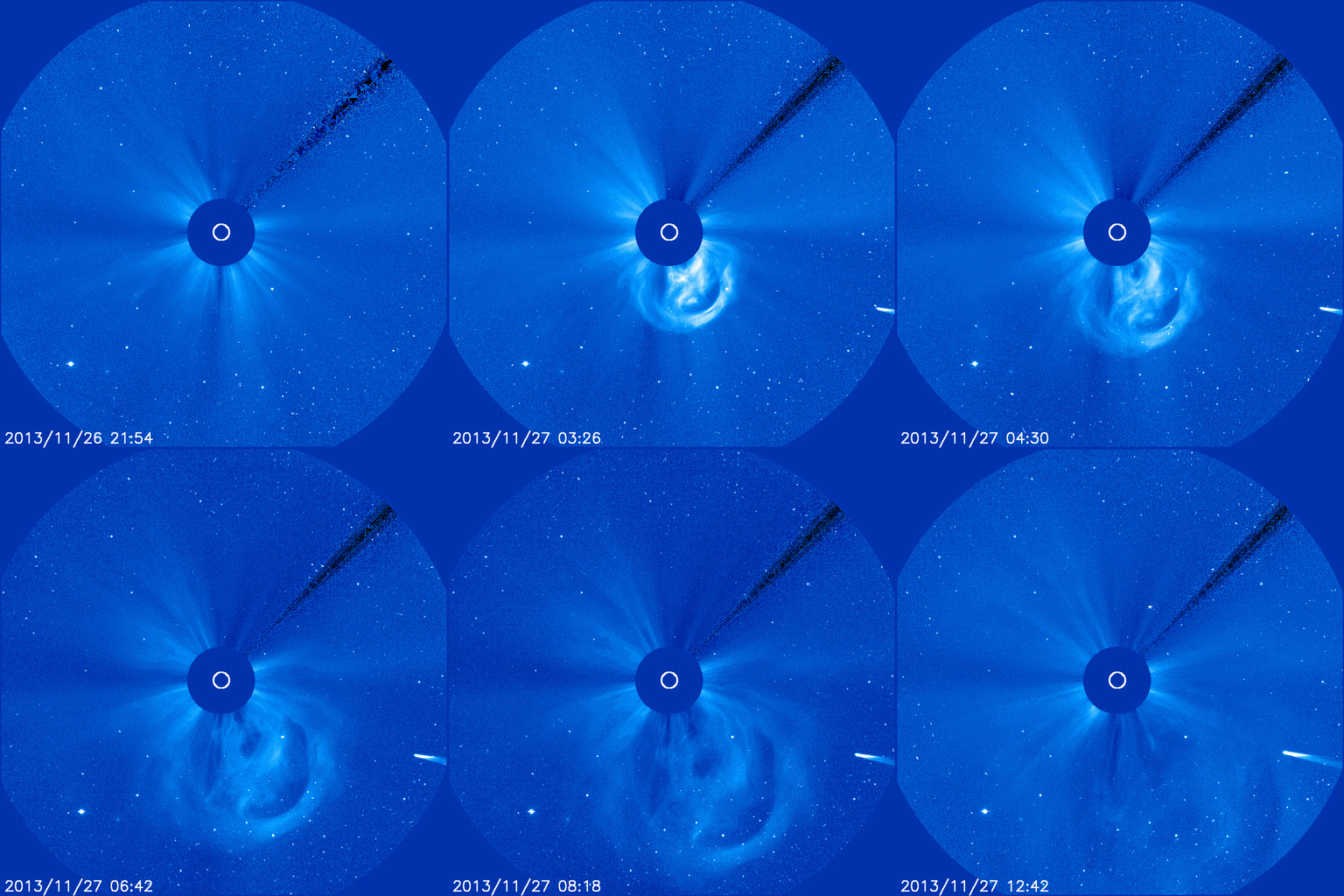
The movie spans a day and a half period from Nov. 27th (01:41 UT) to 28th (15:22 UT). We see that Comet ISON brightened dramatically on Nov. 27th before fading on Nov. 28th. That brightening might have been a disintegration event, in which the comet cracked open and spilled its vaporizing contents into space.
In summary, we still don't know for sure what has happened to Comet ISON. Stay tuned for updates as more data arrive from NASA's fleet of solar observatories. Solar flare alerts: text, voice

Source:

mercredi 27 novembre 2013

Mystérieux bruit d'explosion à l'ouest de Montréal : la thèse du bolide avancée

Plusieurs résidents du Grand Montréal, d'ailleurs au Québec, de l'Ontario et de certains États américains limitrophes rapportent avoir entendu un bruit puissant accompagné de lumières multicolores vers 20 h, mardi soir.
Les témoignages recueillis laissent croire à une météorite, mais pour l'instant, pas de confirmation officielle ni de photos.
« À première vue, on pourrait penser que c'est un bolide - donc une grosse étoile filante - qui serait entré dans l'atmosphère terrestre au-dessus de Montréal, qui se serait vaporisé au-dessus de la ville et qui aurait provoqué un bang supersonique », estime l'astronome de l'Université du Québec à Montréal (UQAM) Pierre Chastenay en entrevue à ICI Radio-Canada Première.
L'astronome souligne qu'une situation similaire s'était produite à Saint-Robert-de-Sorel en 1994.
L'astronome responsable du Club des astronomes amateurs de Laval, Jean-Marc Richard, abonde dans le sens de son collègue Pierre Chastenay. Il compare toutefois le phénomène qui se serait produit à Montréal à celui survenu en Russie le 15 février dernier. « C'est un super-bolide qui a traversé l'atmosphère en Russie alors que ce que nous avons eu, c'est peut-être un bolide, un peu plus petit si vous voulez », explique M. Richard.
« Le problème, c'est que puisque le ciel était couvert à Montréal personne n'a vu la grosse boule de feu ou l'étoile filante qui aurait été associée à ce phénomène-là, ce qui fait qu'on ne peut pas exclure que ce soit un transformateur qui ait explosé », poursuit M. Chastenay.
« Pour l'instant, la meilleure hypothèse c'est celle du gros météore - du bolide - mais faute de témoins visuels on ne peut pas aller plus loin. » — Pierre Chastenay
En astronomie, un bolide est un corps qui entre dans l'atmosphère terrestre en laissant une traînée lumineuse. C'est un gros météore. Une étoile filante, un météore et un bolide sont des phénomènes similaires qui se différencient par la grosseur du corps pénétrant dans l'atmosphère. Une étoile filante se mesure en grammes, un météore en kilogrammes et un bolide en tonnes.
M. Chastenay ne peut toutefois exclure qu'il s'agisse de l'explosion d'un transformateur. Une telle explosion produit également une bonne quantité de lumière et de bruit. L'hypothèse selon laquelle un transformateur de Châteauguay avait explosé a ainsi été avancée, mais Hydro-Québec confirme n'avoir rien à signaler sur l'ensemble de son réseau.
De son côté, la Sûreté du Québec confirme avoir reçu de nombreux appels, sans toutefois pouvoir avancer une explication. Même son de cloche au Service de police de la Ville de Montréal.
Si certains citoyens de Cornwall, en Ontario, et d'Ogdensburg, dans l'État de New York, rapportaient sur les réseaux sociaux avoir entendu un bruit d'explosion, en aucun temps les services d'urgence des deux régions n'ont été interpellés à ce sujet, ont confirmé des porte-parole.
Un tremblement de terre?
Séisme Canada indique n'avoir enregistré aucune vibration. Une porte-parole de l'organisme a cependant précisé qu'un impact de météorite peut ne pas avoir été détecté par les sismographes car, contrairement aux séismes, l'énergie « ne se propage pas dans la terre ».
Selon Environnement Canada, il ne s'agirait pas non plus d'un coup de tonnerre.
Les internautes se perdent donc en conjectures sur les réseaux sociaux, dont Twitter et Facebook.

Source:
http://www.radio-canada.ca/regions/Montreal/2013/11/26/008-bruit-lumiere-explosion.shtml

Pond swallowed by sinkhole fuels legends in Bosnian village

Just outside the village, children fished in a tranquil pond bobbing with green algae and lined with willow trees, as cattle grazed nearby.
Bosnia sinkhole

Now, Rezak Motanic gazes in disbelief down a gigantic crater where the pond used to be. It's like something from a science fiction movie: a sinkhole swallowed the water, the fish and even nearby trees.
"I sat here only a day before it happened, sipping plum brandy," Cemal Hasan said. "And then, there was panic. Fish were jumping out, and a big plum tree was pulled down like someone yanked it with a hook."
Residents of this remote north-western Bosnian village have been in shock since the pond vanished two weeks ago.
The pond was about 20 metres in diameter and about eight metres deep. Now, the "abyss", as the villagers have dubbed the crater, is some 50 metres wide and 30 metres deep – and growing.
Scientists say it is not uncommon that ponds and small lakes suddenly disappear. They say it could be caused by drying underground water currents, or changes in soil drainage due to irrigation.
Sanica villagers, however, are having none of the scientific explanations.
"It could have been a giant cave that opened its doors," offered Milanko Skrbic. "Or a volcano."
Another popular theory – one that experts dismiss along with the others proposed by townsfolk – is that fish could have triggered the explosion of one of several world war two German bombs believed to have been thrown into the pond by an old woman after the war.
"She herself died when one of the bombs exploded in her arms," Cemal Hasan said as he stood on the edge of the "abyss."
Another spooky explanation: the owner of the pond took it with him when he died about a month ago.
"Only days before Hasan passed away he said: 'I'll take everything with me when I die.' And that's what he did," Motanic said. "His daughter saw him walk on the lake the night he died."
Husein Nanic said it could be a sign that the end is nigh. "All sort of miracles happen before the doomsday," he said.

Source:
http://www.theguardian.com/world/2013/nov/26/sinkhole-swallows-pond-in-bosnian-village 


ISON 27 NOV.

COMET ISON, SO FAR SO GOOD: Comet ISON is hurtling toward the sun today at 240,000 mph and, despite the rising heat, the comet appears to be intact. Yesterday, reports of fading spectral lines from the comet's core raised concerns that the icy nucleus might be disintegrating. Current images from NASA and ESA spacecraft, however, show the comet still going strong. Comet ISON has just entered the field of view of the Solar and Heliospheric Observatory (SOHO):

The comet's entrance coincides with a bright CME racing away from the sun's southwestern limb. Astronomers have been wondering what might happen if a CME strikes Comet ISON. This CME, however, will probably miss. The source of the cloud is a farside active region, which is not directly facing the comet.
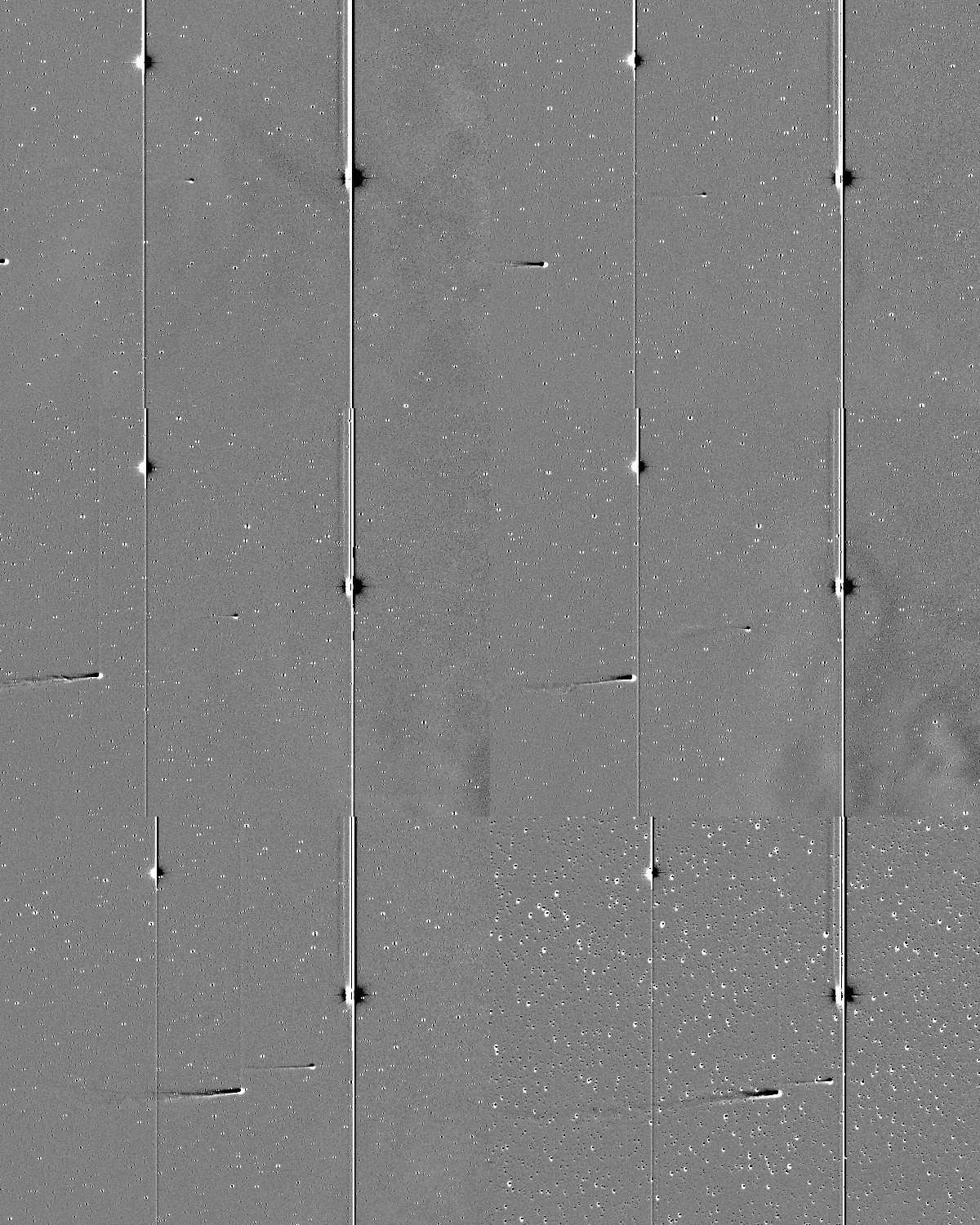
NASA's STEREO-A spacecraft is also monitoring the comet. Click to view a high-resolution movie (32 MB), which compresses 96 hours into less than 1 minute:

Credits: This movie was made by reader Rob Matson using data from STEREO-A.
The movie spans a 3+ day interval from Nov. 21 to Nov. 24 roughly centered on the period when astronomers at the IRAM telescope in Spain recorded fading emission lines from the comet's core. Zoom your movie-player to full screen: Although "puffs" of material can be seen billowing down the comet's tail, the comet itself does not appear to be disintegrating. So what caused the fade...?
"I will admit that I was pretty worried yesterday morning when reports of lower production rates came in," says Matthew Knight of the Lowell Observatory and NASA's Comet ISON Observation Campaign. "However, the STEREO-A brightness has increased steadily over the subsequent 36 hr, and I'm more optimistic again. My off-the-cuff thought is that there was an [outburst of dust, which dampened the emission lines] from roughly Nov 20-22, and it has returned to brightening again."
Astronomer Karl Battams of NASA's Comet ISON Observing Campaign urges readers to remember the following: "Comet ISON is a dynamically new sungrazing comet, fresh in from the Oort Cloud, and the last time we saw an object like this was never! Furthermore, a sungrazing comet just days from perihelion has never been studied in this kind of detail - we're breaking new ground! When we factor in your standard 'comets are unpredictable' disclaimer, what we have is a huge recipe for the unknown."
Stay tuned for updates.

Source:
http://www.spaceweather.com/

lundi 25 novembre 2013

COMET MOVIE--UPDATED

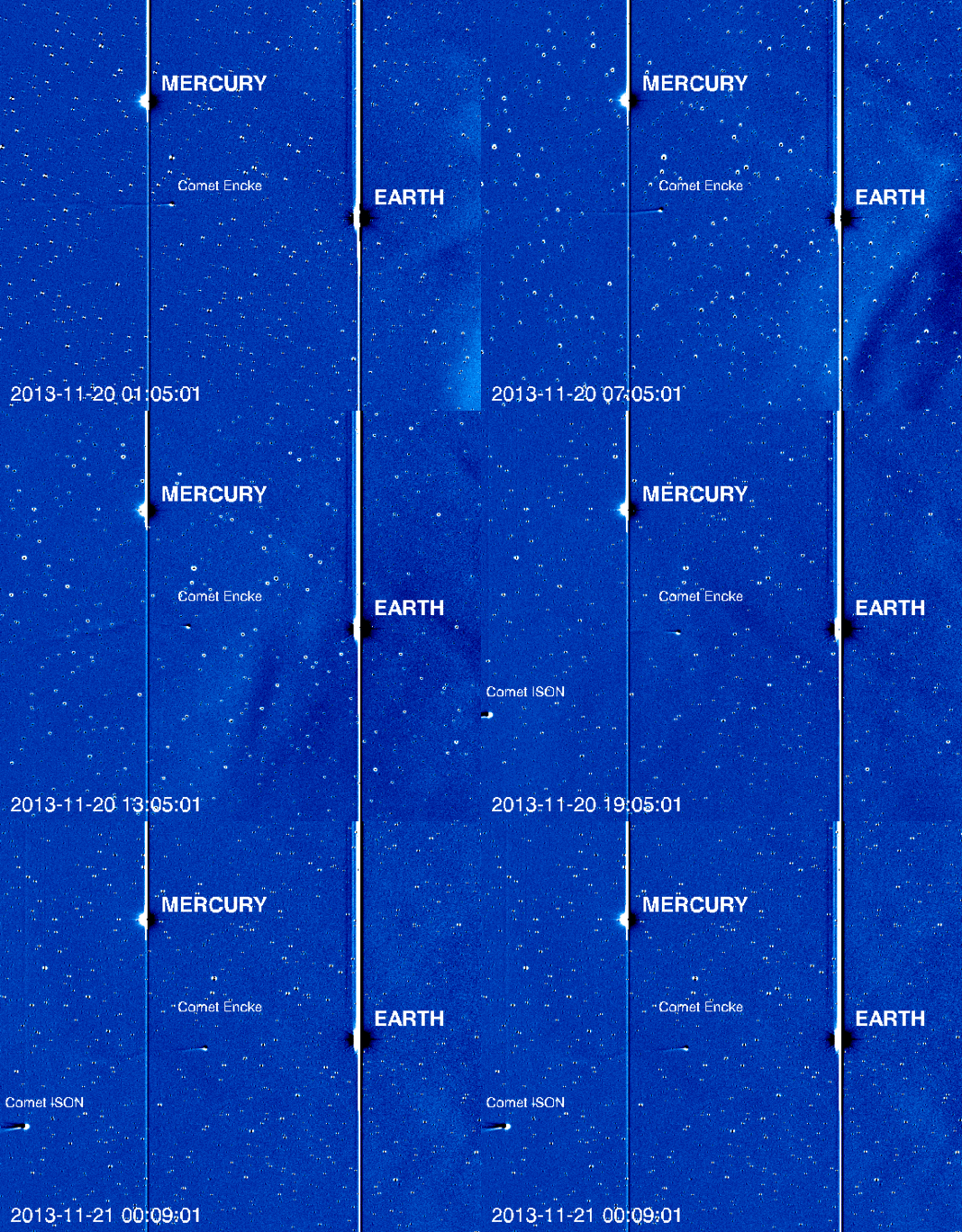
Comet ISON is getting all the press, but there is a second comet near the sun as well: Comet Encke. NASA's STEREO-A spacecraft is monitoring both. Click to view an updated movie of the solar wind buffeting two comets:
In the movie, which spans a three+ day period from Nov. 20 to Nov. 23, the sun is to the right, off-screen. At first glance, Earth and Mercury appear to be labeled backwards. The strange arrangement is actually correct. This is how the two planets appear from STEREO-A's vantage point over the farside of the sun.
"The dark 'clouds' moving from left to right are density enhancements in the solar wind, and these are what are causing the ripples you see in the comet tails," explains Karl Battams of NASA's Comet ISON Observing Campaign.
The ripples could become even more dramatic if a CME hits the comets. This is Comet ISON's first visit to the sun, but Comet Encke has been here before. In 2007 a CME hit Encke and ripped its tail completely off. Battams and other researchers hope something similar is about to happen now. "I'd love to see a big CME hit Comet ISON," he says in a story from Science@NASA. Watching the impact could teach researchers new things about CMEs and comets.
Stay tuned for updated movies from NASA's solar fleet.

Source:
http://www.spaceweather.com/

L'absence de soleil pique la curiosité des scientifiques

Jean-Louis SANTINI
Agence France-Presse
La somnolence inhabituelle du Soleil, qui connaît sa période la moins active depuis plus d'un siècle, aiguise la curiosité des scientifiques qui se demandent combien de temps pourrait encore durer ce calme plat solaire.
Le nombre de taches décomptées depuis le début du cycle actuel, amorcé en décembre 2008, est très faible par rapport à la moyenne quotidienne observée ces 250 dernières années: moins de la moitié.
«Ce cycle, qui devrait très bientôt atteindre son maximum, est intéressant scientifiquement parlant. C'est de loin le moins actif de l'ère de la découverte spatiale, vieille de 50 ans», dit à l'AFP Doug Biesecker, un physicien de l'Agence américaine océanique et atmosphérique (NOAA), précisant qu'un cycle dure en moyenne onze ans.

Observées il y des millénaires par des astronomes chinois et pour la première fois à l'aide d'une lunette par Galilée en 1610, les taches solaires sont importantes, car l'activité électromagnétique intense qui les accompagne produit de fortes modifications des rayonnements ultraviolets et des rayons X ainsi que des tempêtes solaires. Ces dernières peuvent perturber les télécommunications et le réseau électrique sur Terre, souligne Andrés Muñoz Jaramillo, physicien à l'Université du Montana.
Le précédent cycle, le 23e, avait connu son maximum en avril 2000 avec un nombre moyen de 120taches solaires par jour. Ce pic a été suivi par une période très peu active du Soleil qui s'est achevée en décembre 2008, marquant le début du cycle actuel.
En 2009, première année du cycle 24, l'activité du Soleil aurait dû s'accroître, mais les astronomes ont compté 266 jours sans aucune tache solaire.
Compte tenu de la faible activité à la fin du cycle 23, les physiciens avaient prédit un cycle 24 plutôt calme.
«La projection était de 90 taches par jour au moment de l'apogée du cycle prévue d'ici la fin 2013 et il est clair que nous en sommes loin», note Doug Biesecker, même si l'activité solaire s'est un peu accrue depuis un an.
«En 2012, le nombre de taches a plafonné à 67, soit près de la moitié de la moyenne», précise- t-il.
Il faut remonter à l'apogée du cycle 14 en février 1906 pour trouver une activité plus faible, avec un maximum de 64 taches.
«Tout le monde a été surpris par la durée du minimum du cycle actuel qui s'est prolongé trois ans, soit trois fois plus que durant les trois cycles précédents de l'ère spatiale», ajoute Andrés Muñoz Jaramillo, interrogé par l'AFP.
Polarité des champs magnétiques
Outre la faiblesse de son activité, le Soleil connaît des anomalies dans le changement de polarité de ses champs magnétiques.
Normalement, le pôle Sud et le pôle Nord inversent simultanément leur polarité tous les onze ans en moyenne, ce qui correspond à la durée d'un cycle solaire.
Pendant ce processus, les champs magnétiques polaires s'affaiblissent pour tomber à près de zéro et réapparaissent de nouveau quand la polarité est inversée, expliquent les scientifiques.
Mais dans le cycle actuel, les pôles sont désynchronisés. Le pôle Nord a inversé sa polarité il y a plusieurs mois et a donc la même que celle du pôle Sud.
Selon les dernières mesures des satellites, «le pôle Sud devrait inverser à son tour sa polarité très prochainement», indique Todd Hoeksema, directeur de l'Observatoire solaire Wilcox à l'Université de Stanford qui ne paraît pas inquiet de ce phénomène.
Les scientifiques se demandent combien de temps va durer cette accalmie solaire. «Il faudra attendre au moins trois ou quatre ans pour se faire une idée de l'intensité du prochain cycle», estime Doug Biesecker.
Certains chercheurs se demandent si on n'assiste pas au début d'une période prolongée de faible activité solaire comparable à celle du minimum dit de «Maunder» entre 1650 et 1715 durant lequel quasiment aucune tache solaire n'a été observée.
Cette période a coïncidé avec une période de net refroidissement appelé «petit âge glaciaire» en Europe et en Amérique du Nord.
«Il y a eu une forte corrélation entre la faible activité solaire et le petit âge glaciaire (...) le Soleil contribuant à la variabilité du climat», note Doug Biesecker.
Mais ajoute-t-il, «si la faiblesse de l'activité solaire observée dernièrement atténue quelque peu le réchauffement climatique, elle ne l'arrête pas pour autant, la température n'augmentant que plus lentement».

Source:
http://www.lapresse.ca/sciences/astronomie-et-espace/201311/24/01-4714052-labsence-de-soleil-pique-la-curiosite-des-scientifiques.php

Black ‘hail’ rains down on Italian town after eruption

November 25, 2013 – ITALY – An Italian photographer has filmed a town being blanketed in stone and ash as it fell from the sky like hail stones after Mt Etna erupted again on Saturday. Footage shows the town covered in inches of black ash spewed out by the volcano and pushed hundreds of kilometers across the Strait of Messina from Sicily to the mainland. It rained down from dark cloud above and spread over the town’s streets and cars. Some residents used umbrellas to shield them from the chunks of ash that were almost 2cm in size. Mt Etna has erupted several times this year, one as recently as Saturday 16 November, but its last major eruption was in 1992. There were no evacuations from yesterday’s eruption, but a highway was closed for half-an-hour and four air corridors that service Sicily’s Catania Airport, south of the volcano, were closed for some time. – Nine MSN
Source:
http://theextinctionprotocol.wordpress.com/


vendredi 22 novembre 2013

New Era of Neutrino Astronomy Begins at the South Pole


South Pole Telescope

The era of neutrino astronomy has officially begun. Astrophysicists have managed to detect and record the mysterious phenomena known as cosmic neutrinos, which are nearly massless particles that stream to Earth at the speed of light from outside our solar system, striking the surface in a burst of energy that can be as powerful as a baseball pitcher's fastball.

"The era of neutrino astronomy has begun," said Gregory Sullivan, one of the researchers, in a news release.
In this particular study, the researchers observed 28 very high-energy particle events with the use of the IceCube Neutrino Observatory in Antarctica. These events constitute the first solid evidence for astrophysical neutrinos from cosmic sources.  By studying the neutrinos that IceCube detects, the researchers can learn more about the nature of astrophysical phenomena occurring millions, or even billions of light years from Earth.
"The sources of neutrinos, and the question of what could accelerate these particles, has been a mystery for more than 100 years," said Sullivan in a news release. "Now we have an instrument that can detect astrophysical neutrinos. It's working beautifully, and we expect it to run for another 20 years."
In all, IceCube is made up of 5,160 digital optical modules suspended along 86 strings embedded in ice beneath the South Pole. It detects neutrinos through the tiny flashes of blue light, called Cherenkov light, produced when neutrinos interact in the ice. Computers then collect near-real-time data from the optical sensors and send information about interesting events north via satellite.
Since astrophysical neutrinos move in straight lines unimpeded by outside forces, they can act as pointers to the place in the galaxy where they originated. This, in turn, can tell astronomers quite a bit out our universe. The 28 events recorded so far are too few to point to any particular location, but the future looks bright for the study of neutrinos.
The findings are published in the journal Science.

Source:
http://www.scienceworldreport.com/articles/11104/20131122/new-era-neutrino-astronomy-begins-south-pole.htm

SOLAR FLEET PICKS UP COMET ISON

Because NASA's twin STEREO probes are designed to observe the sun, they can see sundiving comets even when the glare becomes intense. Yesterday, Comet ISON joined Earth, Mercury, and Comet Encke in the field of view of STEREO-A's Heliospheric Imager. Click on the image to view ISON's grand entrance:
"The dark 'clouds' of stuff you see coming from the right are density enhancements in the solar wind, and these are what are causing all the ripples you see in comet Encke's tail," explains Karl Battams of NASA's Comet ISON Observing Campaign. "I can pretty much promise you that we're going to see ISON's tail doing that in a couple of day's time, but on a much larger scale!"
Battams points out another exciting development: Comet Encke and Comet ISON are converging for a photogenic close encounter. "No they're not going to hit each other - in reality they are millions of miles apart - but as seen from the STEREO-A spacecraft, they are going to get very close!" he says. "We are probably a couple of days away from seeing two comets almost side-by-side in that camera, with long tails flowing behind them in the solar wind. To say that such an image will be unprecedented is rather an understatement." Stay tuned for that.

Source:

Huge Meteor fall in Ukraine (Multiple views)


Autre Vidéo:
http://www.youtube.com/watch?v=JIq7qyuAP3s

mardi 19 novembre 2013

Meteorite Caught on Dashcam in CQ County, Kansas 16 novembre 2013


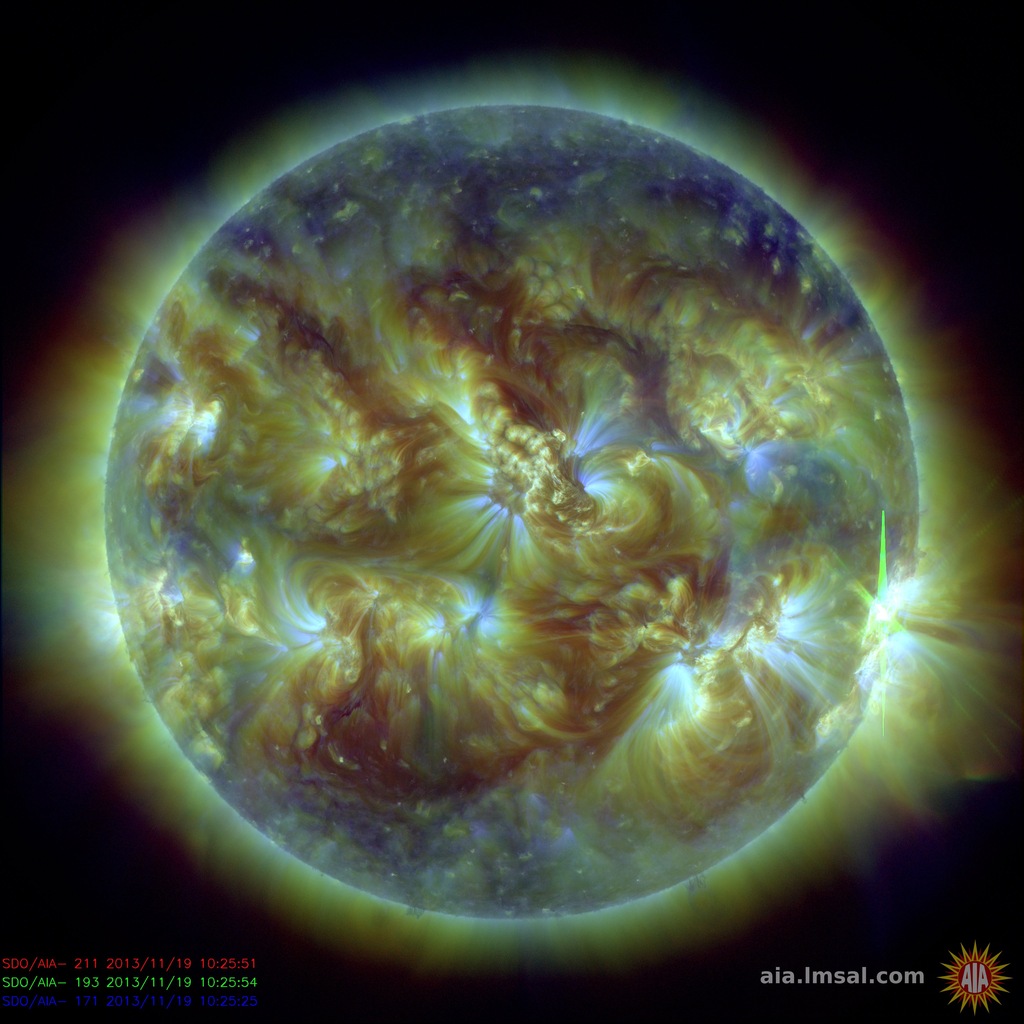
Le Soleil émet un X-Flare ce matin

X-CLASS SOLAR FLARE: Sprawling suunspot AR1897 erupted on Nov. 19th (10:26 UT), producing an X1-class solar flare. NASA's Solar Dynamics Observatory recorded the explosion's extreme ultraviolet flash:
Although the sunspot is not directly facing Earth, the flare did affect our planet. Mainly, the UV flash produced a wave of ionization in the upper atmosphere over Europe, Africa and parts of Asia. A brief blackout of HF radio transmissions around the poles might have also occurred. First-look coronagraph data from NASA's STEREO-Ahead probe show a CME emerging from the blast site, but it is probably not heading for Earth. Stay tuned for updates

Source:
http://www.spaceweather.com/